

One day. Seven phases. Build your business.
Not a day where you just listen and go home with a notebook full of ideas. You open your laptop. Claude sits beside it. And phase by phase, we build the foundation of your business.
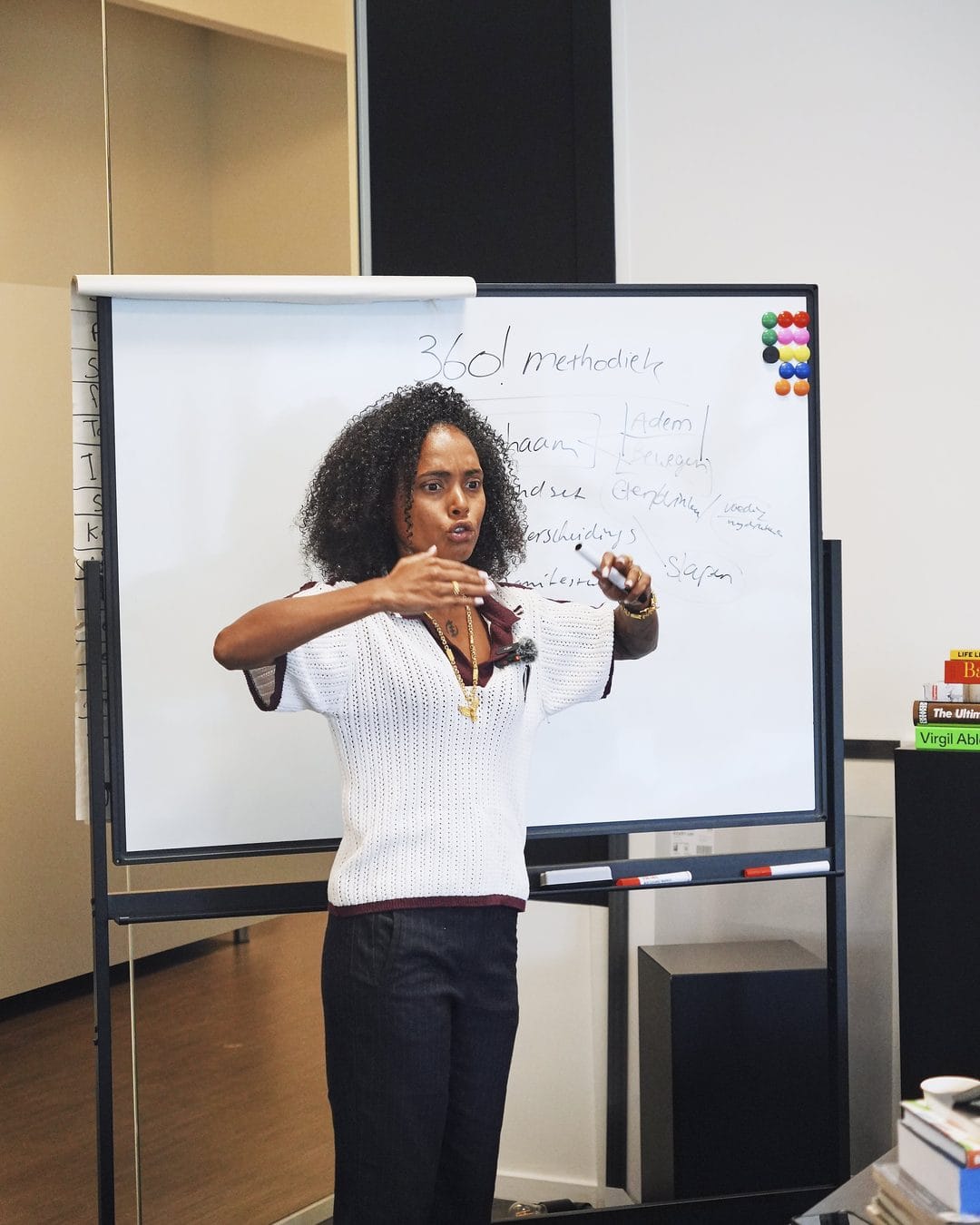
Stop collecting information. Build.
You can spend months watching content about branding, marketing, finances and AI. But in the end, your business doesn't come into being because you collect more information. It has to be built.
That's why at 360! Mastery we spend one full day working through seven parts of your business. You get all the ins and outs explained, phase by phase, from start to finish, so you can lay the foundation yourself afterwards and build it again six months from now.
During the day you actually work on your own business. Pen and paper won't get you far here.
Claude helps you research, analyse, structure and work things out. Every phase is explained to you with the prompts included.
Not random prompts or tools, but a clear route through your business, from your brand to your numbers.
But it can help you build sharper and faster. 360! Mastery is not a Claude training course and not an AI course. Business and leadership are the subject, AI is the tool. A Claude subscription is not required, but it is useful: you can follow along straight away and try every prompt yourself on the spot. Without a subscription you still take part fully and set it up at home.
The seven phases of your foundation
Every phase is explained from start to finish: what it is, why your business needs it, how you build it and with which prompts. You see it happen before your eyes and ask your questions as it happens.
Brand book and logo
Colour, typography, tone, what your brand is and what it never is. You learn how a logo is built and how to capture those choices in a brand book a designer could read tomorrow.
Why this needs to be in order. Without a defined visual identity, every post, every invoice and every quote looks different, and you make the same decisions over and over. With a brand book you become recognisable, you work faster and you can outsource work without your brand falling apart.
Real social media analysis
Not looking at likes, but learning to read what your numbers are really telling you. Which content works, which content costs you money and where your audience drops off.
Why this needs to be in order. As long as you post on gut feeling, you pay with your time for content that does nothing. Once you can read your own numbers, you stop guessing and adjust based on what demonstrably works.
Competitor analysis
Who is active in your market, what they promise, what they charge and where they are strong. And above all: how to find the gap where you fit.
Why this needs to be in order. Your price, your promise and your position don't exist on their own, they exist alongside everyone else's. Once you have mapped the market, you can explain in one sentence why someone should choose you.
Target audience and psychological deep dive
Beyond age, location and interests. What keeps your customer up at night, what holds them back, how they search, how they choose and which words they use themselves.
Why this needs to be in order. An offer that doesn't connect with what is going on in your customer's mind won't sell, however beautifully you write it. When you truly know your customer, you write faster and don't have to persuade.
Your marketing strategy
Everything from phases 1 to 4 comes together here. Positioning, offer, channels, message and the route from stranger to customer. On one page, so you actually use it.
Why this needs to be in order. Scattered actions without a strategy are the most expensive way to run a business there is. With a strategy on one page, you know what you say yes to and what you say no to.
Your finances and unit economics
What one customer costs you and what they bring in. Revenue, costs, margin, your offer, your customer value and your acquisition. Looking back at your numbers and looking ahead to next year.
Why this needs to be in order. If you don't know what a customer costs and brings in, you also don't know whether growth moves you forward or drains you. Once you know your unit economics, you can justify a price and set a budget.
Your 90-day content calendar
Not a calendar full of random ideas, but a calendar that follows directly from your strategy. You learn how to fill ninety days without having to come up with what to post every morning.
Why this needs to be in order. Trust is built through consistency, and consistency comes from planning, not inspiration. That way your brand doesn't go quiet when you're away for a week.
All with AI alongside
Every phase is explained with the prompts included. You learn not only what should sit underneath a business, but also how to set it up yourself at home and how to do it again six months from now.
Reserve My SeatWhat the day looks like
Seven phases, one Saturday, your foundation.
You don't just go home with notes.
During the day you have actually worked on seven parts of your business. And you have seen a way of working that lets you keep using AI after 360! Mastery to research, analyse and improve your business.
- Your brand foundation
- Your social media presence
- Your competitive position
- Your target audience
- Your marketing strategy
- Your financial business logic
- Your content direction for ninety days
You won't leave here with ready-made files someone else made for you. You leave with the knowledge, the order and the prompts, so you can build this yourself at home. That's deliberate: whatever someone makes for you, you'll have to pay someone to make again a year from now. What you can build yourself stays with you for the rest of your life as an entrepreneur.
At least €12,500 worth of work. You invest €350.
These are the amounts an agency or a strategist charges to make these parts for you. Not to make it seem expensive, but because you should know what the work you learn to do on this day is worth. If you pay an agency, the knowledge stays with them. If you learn it yourself, it stays with you for good.
This is your day if you're coming to work.
This is for you
- You have a business and feel the foundation is missing
- You want to start and have no idea where to begin
- You create content without a strategy behind it
- You don't know whether your investments stack up against your costs
- You can't explain what makes you different from the rest
- You want to work with AI but don't know how to use it seriously
- You want to be able to do this yourself from now on, instead of outsourcing it every year
This is not for you
- You expect everything to be built for you
- You expect AI to take over the decisions
- You'd rather have a day of inspiration than a day of work
- You don't want to take an honest look at your own numbers
- You expect one day to answer all your questions
There are 15 seats, seven phases and seven hours. That's tight, and that's the point. No more seats will be added, because then I could no longer sit at the table with everyone.
Why the Waldorf Astoria
I could have held this day in a small room above a café. It would have been cheaper. But it wouldn't be right.
Where you work on your foundation helps determine how seriously you take it. That's why we're on the Herengracht, in six listed canal houses from the seventeenth and eighteenth centuries, right in the middle of the UNESCO World Heritage canal ring.
These houses were built by people who traded all over the world and who built to last. The grand staircase was designed by Daniel Marot, once an architect in the service of Louis XIV. Behind the house lies a private garden, quiet, in the middle of the busiest city in the country.
Today this is one of the addresses in Amsterdam where luxury, quality and big names come together. On 28 November, you'll be sitting there. Not as a guest taking a quick look around, but with your laptop open, learning how to build your own business.
That's not a backdrop. It's a commitment to yourself: I'm serious about this, so I treat it that way.
And on a practical note: it's a long day. You'll want to sit comfortably, eat well and work in a space that calms you rather than tires you out.
Four centuries
Six listed canal houses at Herengracht 542 to 556, built by merchants who thought in generations.
15 chairs
No hall with rows of chairs. One room, 15 laptops and Des Balentien joining everyone at the table.
Catered from 10:00 to 17:00
Lunch, coffee, tea and soft drinks are taken care of. All you need to think about is your business.
The address
Waldorf Astoria Amsterdam
Herengracht 542 to 556, 1017 CG Amsterdam
Doors open from 09:30. Check in at reception and they will show you to our room.
Getting there
By public transport. Trams 4 and 14 stop at Keizersgracht, about a three-minute walk. Metro lines 51, 53 and 54 stop at Waterlooplein, about a seven-minute walk.
By car. Plan on a car park near Waterlooplein, about a ten-minute walk. A cheaper option is P+R Johan Cruijff ArenA, from where metro 54 runs directly to Waterlooplein.
By bike. You can park in the racks along the Herengracht and the Utrechtsestraat. Arrive fifteen minutes early, because when they're full, they're full.
Des Balentien
Entrepreneur, speaker and author. Creator of the 360! Method. I have built businesses, had to rebuild them, and seen up close what happens when the foundation isn't right.
On 28 November I won't give you theory you still have to translate at home, nor a folder of work I made for you. I'll explain phase by phase how each part is built, I'll look at your numbers with you and I'll tell you honestly what I see. So you can build it yourself at home.
Lobi and Light · Des Balentien · 360! Community
360! Mastery
- The full Mastermind from 10:00 to 17:00
- Seven phases, from your brand book to your content calendar
- Lunch
- Coffee
- Tea
- Soft drinks
- Waldorf Astoria Amsterdam
What you need to know
- Saturday 28 November 2026
- 10:00 to 17:00, doors open from 09:30
- Maximum of 15 participants
- Bring: your laptop, your charger and your own numbers
- A Claude subscription is not required, but it is useful
- Full amount paid upfront, your invoice follows by email with VAT shown separately
- Can't make it? Your seat is transferable. Let us know at least one week in advance with the name of the person taking your place